


The Game of Knowledge: Playing at Spiritual Liberation in Eighteenth- and Nineteenth-Century Western India by Jacob Schmidt-Madsen
The Game of Knowledge: Playing at Spiritual Liberation in Eighteenth- and Nineteenth-Century Western India
AUTHOR- Jacob Schmidt-Madsen
| HB ₹7995 |
||
INFORMATION
- AUTHOR : Jacob Schmidt-Madsen
- HB ISBN : 978-93-0961-619-8
- Year : 2026
- Extent : 730
- Discount available on checkout
- Usually dispatched within 3 to 5 working days.
“From religious diagrams of the universe to a children’s classic, cultural historian Jacob Schmidt-Madsen traces the journey of Gyan Chaupar and the making of modern Snakes and Ladders.” (Read the full article here 🔗)
– Adrija Roychowdhury, The Indian Express
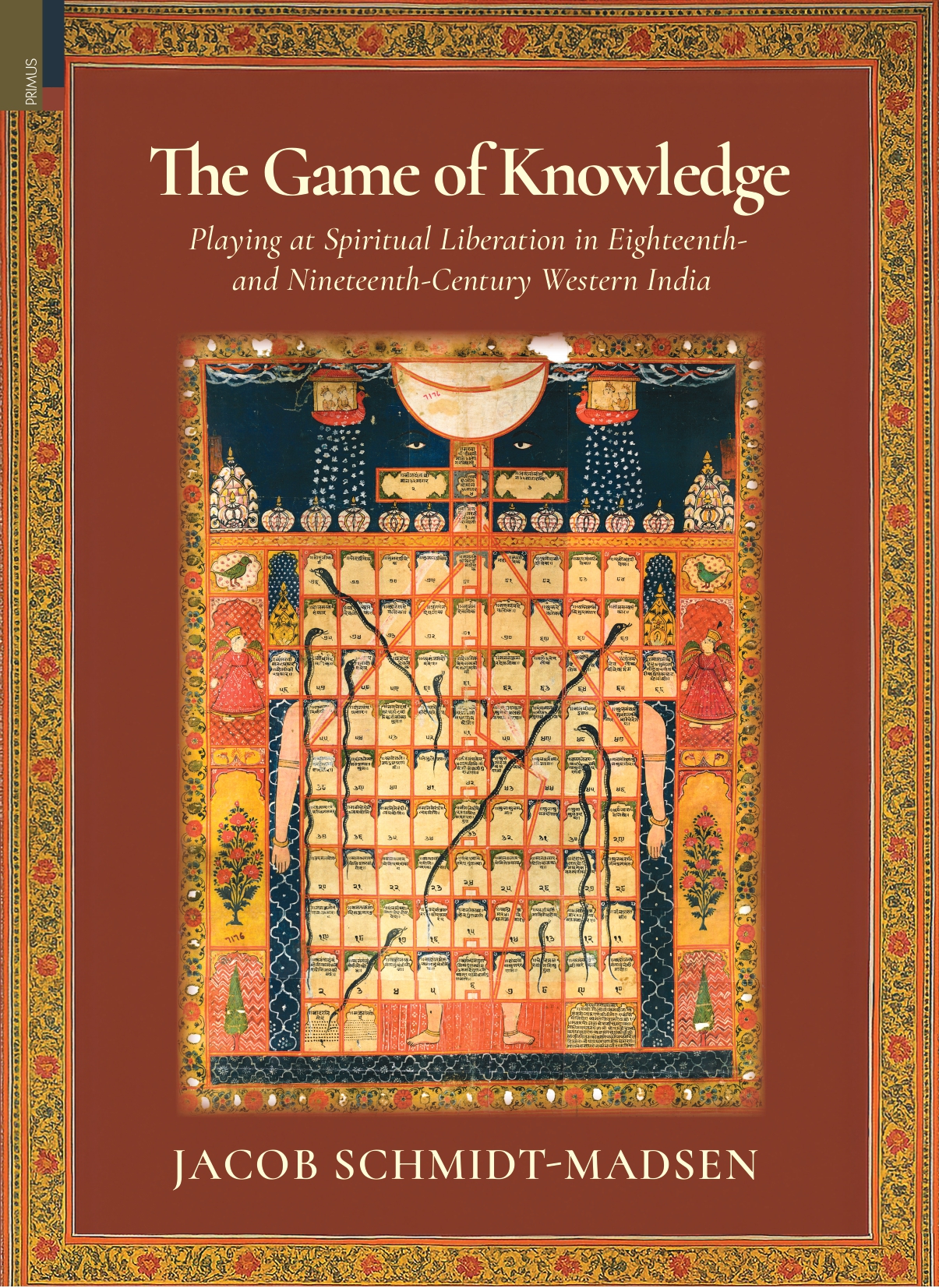
Snakes and Ladders is one of the most successful board games ever marketed. It was introduced by British game manufacturers in the late nineteenth century, but its history can be traced back to the religious Vaishnava and Jaina communities in eighteenth-century Western India. It was known there as the ‘Game of Knowledge’ and variously used for entertainment, education, divination, and self-exploration. The board was a map of the universe, the pawns were the souls traveling through it, the dice the karma controlling them, and the snakes and ladders the ups and downs on their journey toward spiritual liberation.
The Game of Knowledge: Playing at Spiritual Liberation in Eighteenth- and Nineteenth-Century Western India tells the fascinating story of board games from its origin in mystical charts of the astral body to its modern adaptation as an abstract children’s game. The story is told through beautifully handcrafted gameboards and little-known texts and manuscripts. The facts are presented with scholarly rigour yet easily grasped by the attentive reader.
Contents
PART 1: STUDY
List of Figures and Tables
Note on Transliteration
List of Abbreviations
Preface
Acknowledgements
Introduction
- What’s in a Game?
- The Beginnings of Gyān Caupaṛ
- Source Material
- Critical Reading and Analysis
- Simulation and Narrative
- Related Cultural Forms and Practices
Conclusion
Bibliography
PART 2: APPENDICES
Appendix A: Game Charts
A1: Provenance
A2: Description
Appendix B: Typology
B1: Vaiṣṇava Charts
B2: Jaina Charts
B3: Ṣūfī Charts
B4: Advaita Vedānta Charts
B5: Unidentified Charts
Appendix C: Transcriptions
C1: 72-Square Vaiṣṇava Charts
C2: 84-Square Jaina Charts
Appendix D: Critical Readings
D1: 72-Square Vaiṣṇava Charts (Type a)
D2: 84-Square Jaina Charts (Type a1)
Appendix E: Game Verses
E1: Verses on Vaiṣṇava Charts
E2: Verses on Jaina Charts
Appendix F: Game Texts
F1: Krīḍākauśalya
F2: Jñān Bājī Ramvānī Rīt
Index
The Author
Jacob Schmidt-Madsen is a historian of board games specializing in traditional South Asian games. Currently based at the Max Planck Institute for the History of Science, his research explores how formal game systems are invested with meaning and used for purposes of ritual, divination, education, and other playful yet serious practices. He employs a wide range of textual, visual, material, and ethnographic sources collected from private and public archives and during fieldwork.