


Corporate Philanthropy and Epidemics: Rockefeller Foundation and Anti-Hookworm Campaigns in Early Twentieth Century Fiji by Raj Sekhar Basu
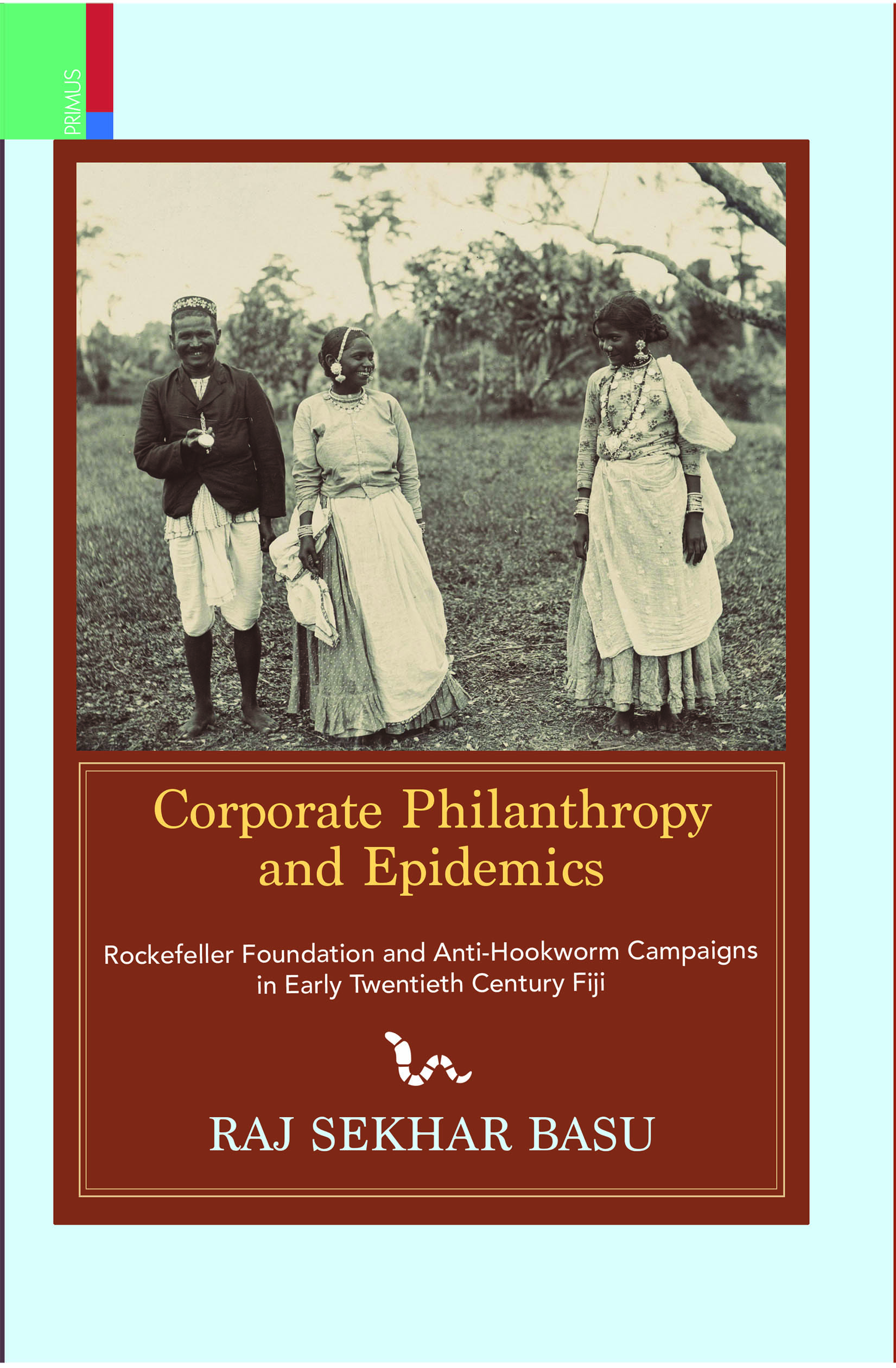
Corporate Philanthropy and Epidemics: Rockefeller Foundation and Anti-Hookworm Campaigns in Early Twentieth Century Fiji
AUTHOR- Raj Sekhar Basu
| HB ₹1750. $79.65. £63.95 |
||
INFORMATION
- AUTHOR : Raj Sekhar Basu
- HB ISBN : 978-93-7452-450-3
- Year : 2026
- Extent : 868
- Discount available on checkout
- Usually dispatched within 3 to 5 working days.
Corporate Philanthrophy and Epidemics examines the Rockefeller Foundation’s involvement in the hookworm eradication programme in colonial Fiji, framed within the rise of corporate philanthropy in the United States during the late nineteenth century. Influenced by the Social Gospel movement, industrialists like Carnegie established foundations to address social issues. Inspired by this model, the Rockefellers funded the Rockefeller Sanitary Commission to combat hookworm in the American South, a disease dubbed the ‘lazy disease’ for its impact on worker productivity, particularly in plantations.
The success of this campaign led to a global hookworm eradication programme under the International Health Board. Fiji, then a British colony, was selected as a key site for implementation during the 1920s and 1930s, largely due to the efforts of Dr Samuel Lambert, whose prior experience with public health issues in the Pacific informed the initiative. The colonial administration, despite financial limitations, supported the programme. Lambert also focused on Indian indentured labourers, who suffered from poor sanitation. Interventions included improved sanitary measures and borehole latrines.
Although the War curtailed funding and limited Rockefeller’s involvement, the programme drew attention to emerging fields like epidemiology and public health. The case of Fiji highlights the significant role that non-state actors, such as philanthropic foundations, played in shaping global health initiatives.
The Author
Raj Sekhar Basu is Professor in the Department of History, University of Calcutta, Kolkata. His earlier publications include Nandanar’s Children: The Paraiyar’s Tryst with Destiny, Tamil Nadu 1850–1956 (2011); as well as edited volumes Narratives from the Margins: Aspects of Adivasi History in India (with Sanjukta Dasgupta, 2011); and Medical Encounters in British India (with Deepak Kumar, 2013).
His research work engages with historiography, identity narratives, and the bureaucratic dimensions of cultural policy. He teaches at Sciences Po and INALCO and is associated with the Centre for South Asian and Himalayan Studies (CNRS-EHESS) in Paris. He has previously worked in the foreign policy sector in Delhi and Mumbai.