


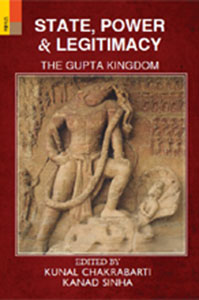
State, Power and Legitimacy
EDITOR : Kunal Chakrabarti and Kanad Sinha
| HB ₹1995 . $104.95 . ₤79.95 |
PB ₹1195 . $74.95 . ₤59.95 |
|
INFORMATION
- EDITOR : Kunal Chakrabarti and Kanad Sinha
- HB ISBN : 978-93-5290-280-4
- PB ISBN : 978-93-5290-279-8
- Year : 2019
- Extent : 972 pp.
- Discount available on checkout
- Usually dispatched within 3 to 5 working days.
Tagore
| HB ₹ 995 . $ . ₤ |
PB ₹ . $ . ₤ |
|
| POD ₹ . $ . ₤ |
e-Book ₹ . $ . ₤ |
INFORMATION
- AUTHOR –
- ISBN – 978-93-84082-78-9
- Year – 2016
- Extent: 400 + 40 coloured illustrations
- 10% discount + free shipping
- Usually dispatched within 3 to 5 working days.
State, Power & Legitimacy: The Gupta Kingdom presents a comprehensive account of the Gupta state, with particular emphasis on its strategies of legitimizing its power. The political strategies that characterized this crucial juncture of early Indian history, termed ‘threshold times’ by Romila Thapar, employed certain features of ancient Indian polity even as new political mechanisms were emerging. This volume argues that this unique combination of political strategizing was a part of the process of legitimizing royal authority, in which religion, literature and art were essential tools. The volume also includes a large selection of prepublished essays which provide the reader with a comprehensive idea of how the Gupta state has been studied by earlier historians together with recent articles which help us to look at the Gupta state and the manner in which it exercised and legitimized its power. A substantive introduction suggests the need to move beyond the nationalist perspective that views the rule of the Guptas as the ‘Golden Age’ or the Marxist model of ‘Indian feudalism’.
Kunal Chakrabarti is Professor of Ancient Indian History at the Centre for Historical Studies, Jawaharlal Nehru University. He had also been a Visiting Professor to Colorado College and to the University of Chicago. His research interests include social history of religion, regional histories with special reference to Bengal, history of the environment with special reference to the forest, early Indian political ideas and institutions, and early Indian textual traditions. He is the author of Religious Process: The Puranas and the Making of a Regional Tradition (2000) and Historical Dictionary of the Bengalis (2013).
Kanad Sinha is Assistant Professor of History, Udaynarayanpur Madhabilata Mahavidyala, Howrah. He has published several articles in important journals like Medieval Worlds, The Journal of Bengal Art, Studies in History, Studies in Humanities and Social Sciences and International Journal of Hindu Studies, on various aspects of social and cultural History of early India, especially early Indian historical traditions.
As a global figure, Tagore transcends the boundaries of language and reaches out to people distant both in time and space. His art took inspiration from contemporary Western trends and became a powerful means to connect with people beyond Bengal. Word, image, song, and text were his tools of communication, as also his extraordinary presence in a sartorial garb of his own design. A littérateur in many genres, the impact of his work was determined both by the material he presented, and by its simultaneously local and global contexts. Now, when his international reputation has spanned over more than a hundred years, it is important to revisit the sites of Tagore’s eminence, and ask to what extent he was a ‘living text’ in the century that witnessed him as a global intellectual.
Accordingly, this volume investigates how Tagore’s writings and art are linked to the metalinguistic domains of the psychological, medical and mythical; how he was received in various cultures outside India; how his art was determined by individual circumstances and global aspirations; and how he acted as an inspiration to his contemporaries and subsequent generations including modern Indian writers and artists.
The Editor
Imre Bangha studied in Budapest and Santiniketan and at present is Associate Professor of Hindi at the University of Oxford. He has published books and essays in English, Hindi, and Hungarian on literature in Brajbhasha and other forms of old Hindi and has also prepared Hungarian translations from various South Asian languages. His work on the international reception of Bengali culture includes Rabindranath Tagore: Hundred Years of Global Reception (2014, co-edited with M. Kämpchen) and Hungry Tiger: Encounter between India and Central Europe (2007).
Table of Contents
Table of Contents
| A Note for the Readers | xiii |
| Acknowledgements | xv-xviii |
| Revisiting the Gupta Kingdom State, Power and Legitimacy Kanad Sinha | 1-40 |
| Section I Overview and Sources | |
|---|---|
| The Gupta Kingdom K. Chakrabarti | 43-64 |
| Gupta History and Literature: A Bibliographic Essay Eleanor Zelliot | 65-88 |
| Archaeological Remains of the Gupta Period K.N. Dikshit | 89-104 |
| The Five Dåmodarpur Copper-plate Inscriptions of the Gupta Period Radhagovinda Basak | 105-153 |
| Problem of the Identity of King ‘Candra’ of the Meharauli Prasasti S.R. Goyal | 154-162 |
| Meharauli Iron Pillar Inscription and Candra Gupta II: A Reassessment Kanad Sinha | 163-169 |
| The Coinage A.S. Altekar | 170-180 |
| Section II Origin of the Guptas | |
| The Origin of the Imperial Guptas B.G. Gokhale | 183-188 |
| Social Milieu of the Guptas S.R. Goyal | 189-199 |
| e Gupta Era: A Re-assessment Parmeshwari Lal Gupta | 200-217 |
| Section III The Foundation of the Empire | |
| e Rise of the Guptas R.C. Majumdar | 221-228 |
| Kaca: A Step Brother of Samudragupta Parmeshwari Lal Gupta | 229-234 |
| Kaca Problem Solved parmeshwari Lal Gupta | 235-237 |
| Identification of the Princes and Territories Mentioned in the Allahabad Pillar Inscription of Samudragupta D.R. Bhandarkar | 238-247 |
| Allahabad Inscription of Samudragupta Is Not Posthumous B. Chhabra | 248-257 |
| Unification of the Ganga Valley S.R. Goyal | 258-291 |
| Section IV The Consolidation of the Empire | |
| Candra-Gupta II (Vikramåditya) and His Predecessor K.P. Jayaswal | 295-313 |
| The Tradition of Rama Gupta and the Indian Nationalist Historians S.N. Mukherjee | 313-319 |
| Candra Gupta II Vikramaditya H.C. Raychaudhuri | 320-330 |
| The ‘Nava-Ratna’ at Vikramaís Court D.C. Sircar | 331-335 |
| Vikramaditya in Jain Tradition H.D. Velankar | 336-359 |
| Kumaragupta I and the South S.R. Goyal | 360-367 |
| Govindagupta S.V. Sohoni | 368-374 |
| The Vakatakas and Their Place in the History of India S.K. Aiyangar | 375-398 |
| A Note on the Rule of the Vakatakas B.N. Mukherjee | 399-406 |
| The Vakataka Queen Prabhavati Gupta R.C. Majumdar | 407-410 |
| The Period of Construction: Rudrasena II and Prabhavati Gupta Hans Bakker | 411-419 |
| Section V Decline of the Guptas | |
| Skanda Gupta Vikramaditya H.C. Raychaudhuri | 423-430 |
| Budhagupta S.R. Goyal | 431-432 |
| Later Gupta History: Inscriptions, Coins and Historical Ideology Michael Willis | 433-462 |
| The Disintegration of the Empire R.C. Majumdar | 463-472 |
| Section VI The Apparatus of the Empire | |
| Political Theory and Administrative Organisation U.N. Ghoshal | 475-482 |
| Land Ownership and Kingís Right to Taxes Dwijendra Narayan Jha | 483-494 |
| Assessment of Land Revenue in Post-Maurya and Gupta Times (c.200 BC–AD 600) Dwijendra Narayan Jha | 495-500 |
| Gupta Polity: Military Organisation V.R.R. Dikshitar | 501-515 |
| Indian Feudalism: Origins and First Phase (c. AD 300-750) R.S. Sharma | 516-577 |
| Agrarian Structure in Central India and the Northern Deccan (c. ad 300-500): A Study of Vakataka Inscriptions Krishna Mohan Shrimali | 578-611 |
| Subordinate Rulers under the Gupta Monarchs: Political Integration and State Formation in Central and Eastern India Ashish Kumar |
612-638 |
| The Mandasor Inscription of the Silk-Weavers A.L. Basham | 639-651 |
| Section VII Religion and the State | |
| Religious Toleration under the Imperial Guptas R.S. Tripathi | 655-664 |
| Royal Patronage and Religious Tolerance: The Formative Period of Gupta-Vakataka Culture Hans Bakker | 665-683 |
| Puranic Vaisnavism and the Guptas: A Study of Kingship, Legitimacy and Religion Kanad Sinha | 684-690 |
| The Image of the Heretic in the Gupta Puranas Wendy Doniger O’flaherty | 691-710 |
| Feudalism and Mahåyåna Buddhism A.K. Warder | 711-728 |
| Section VII Culture and the Legitimization of Royal Authority | |
| The Power of a Poet: Kingship, Empire, and War in Kalidasa’s Raghuvamsa Upinder Singh | 731-759 |
| Seeing and Hearing: Representations of Kingship in the Abhijnanasakuntalam and the Raghuvamsam of Kalidasa Kumkum Roy | 760-778 |
| History as Literature: The Plays of Visakhadatta Romila Thapar | 779-801 |
| Some Royal Poets of the Vakataka Age V.V. Mirashi | 802-811 |
| Historical and Political Allegory in Gupta Art Frederick M. Asher | 812-824 |
| List of Abbreviations | 825-826 |
| Selected Readings for All Chapters Containing Footnotes | 827-872 |
| A Select Bibliography on the Gupta Period | 873-91 |
| Index | 917-951 |