


INFORMATION
- AUTHOR : Megan Moodie
- ISBN : 978-93-86552-48-8
- Year : 2017
- Extent : 230 pp.
- For sale only in South Asia
- Discount available on checkout
- Usually dispatched within 3 to 5 working days.
INFORMATION
- AUTHOR : Megan Moodie
- ISBN : 978-93-86552-48-8
- Year : 2017
- Extent : 995
- 10% discount + free shipping
- Usually dispatched within 3 to 5 working days.
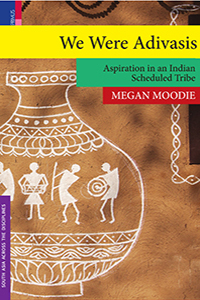
In We Were Adivasis, anthropologist Megan Moodie examines the Indian state’s relationship to ‘Scheduled Tribes’, or adivasis—historically oppressed groups that are now entitled to affirmative action quotas in educational and political institutions. Through a deep ethnography of the Dhanka in Jaipur, Moodie brings readers inside the imaginative work of these long-marginalized tribal communities. She shows how they must simultaneously affirm and refute their tribal status at a range of levels, from domestic interactions to historical representation, by relegating their status to the past: we were adivasis.
Megan Moodie is Assistant Professor of Anthropology, University of California, USA.
In We Were Adivasis, anthropologist Megan Moodie examines the Indian state’s relationship to ‘Scheduled Tribes’, or adivasis—historically oppressed groups that are now entitled to affirmative action quotas in educational and political institutions. Through a deep ethnography of the Dhanka in Jaipur, Moodie brings readers inside the imaginative work of these long-marginalized tribal communities. She shows how they must simultaneously affirm and refute their tribal status at a range of levels, from domestic interactions to historical representation, by relegating their status to the past: we were adivasis.
The Author
Megan Moodie is Assistant Professor of Anthropology, University of California, USA.
Table of Contents
Table of Contents
| Acknowledgments | Ix-Xi |
| Introduction | 1-27 |
| Who Are The Dhanka? | 28-56 |
| What It Takes | 57-78 |
| A Traffic In Marriage | 107-133 |
| A Good Woman | 79-106 |
| Wedding Ambivalence | 134-150 |
| Of Contracts And Kaliyuga | 151-17 |
| Conclusion: On Collective Aspiration | 171-182 |
| A Short Glossary | 183 |
| Notes | 185-200 |
| Bibliography | 201-212 |
| Index | 213-217 |