


The Hidden String: Agrarian Economy of Colonial Bengal and Its Institutional Framework by Binay Bhushan Chaudhuri
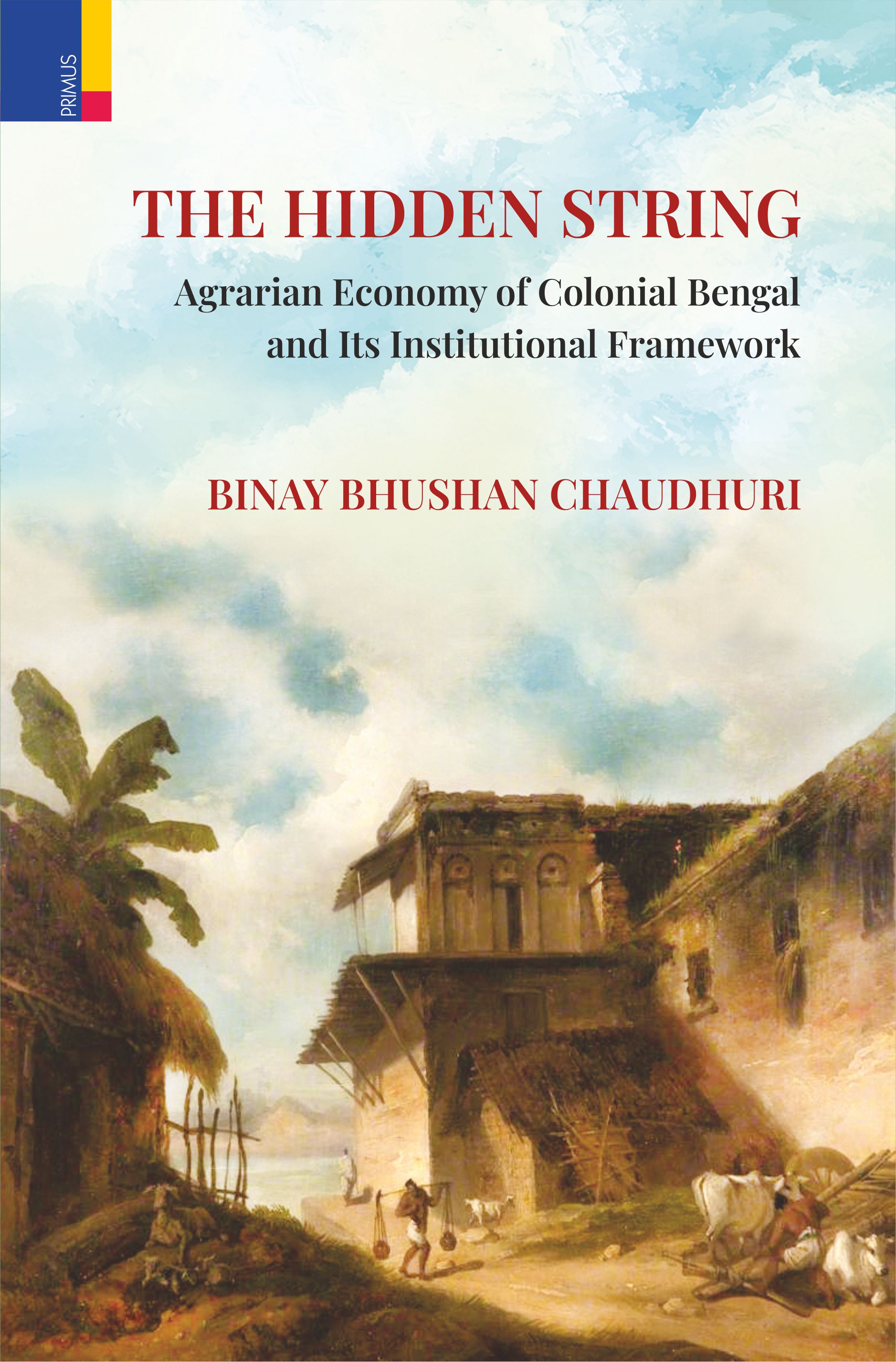
The Hidden String: Agrarian Economy of Colonial Bengal and Its Institutional Framework
AUTHOR- Binay Bhushan Chaudhuri
| HB ₹2650. $109.95 . ₤89.95 |
||
INFORMATION
- AUTHOR : Binay Bhushan Chaudhuri
- HB ISBN : 978-93-7033-013-9
- Year : 2025
- Extent : 934
- Discount available on checkout
- Usually dispatched within 3 to 5 working days.
The Hidden String is a remarkable study undertaken over a two-and-a-half decades and revisited after a gap of three decades. It examines the intricate relationship between agricultural practices and institutional frameworks in rural Bengal in the colonial period. At its core, the work elaborates two fundamental concepts: the nature of agricultural production and the institutional structures that governed it. The analysis of agrarian systems reveals how cultivation patterns were linked to ecological constraints and climate rhythms. Particular attention is paid to Bengal’s principal crops—aus and aman—whose cultivation cycles shaped not only agricultural practices but also broader socio-economic patterns of rural life. The book also examines traditional water management systems, which not only consolidated power structures within village communities but also triggered peasant resistance.
A key theme is the institutional framework of agriculture, which is examined through inter-connected socio-cultural practices and structures: from government legislation and rural credit systems to agencies controlling commercial crop cultivation, demographic growth, and the impact of epidemiological events and irregular precipitation patterns.
This comprehensive study is a testament to the complex interplay between agricultural practices and the institutional mechanisms that shaped the economic landscape of rural Bengal from the eighteenth to the first half of the twentieth century.
Contents
List of Tables
List of Abbreviations
Preface
Acknowledgments
Introduction
1. Agricultural Growth in Bengal and Bihar, 1770–1860
2. Agricultural Production in Bengal and Bihar: Co-existence of Decline and Growth, 1859–1885
3. Growth of Commercial Agriculture in Bengal and its Impact on the Peasant Economy, 1859–1885: Part I
4. Growth of Commercial Agriculture in Bengal and its Impact on the Peasant Economy, 1859–1885: Part II
5. Rural Power Structures and Agricultural Productivity in Eastern India, 1757–1947
6. Rural Credit Relations in Bengal, 1859–1885
7. Control over Rural Credit and Peasant Society in Bengal and Bihar, 1885–1947
8. Movement of Produce Rent in Eastern India, 1793–1930
9. Land Market in Eastern India, 1793–1940: Part I: The Movement of Land Prices
10. Land Market in Eastern India, 1793–1940: Part II: The Changing Composition of the Landed Society
11. The Story of a Peasant Revolt in a Bengal District
12. The Agrarian Question in Bengal and the Government, 1850–1900
Conclusion
Bibliography
Index
The Author
Binay Bhushan Chaudhuri retired as Professor at the University of Calcutta. He was Professor of economic and social history at the university from 1960 to 1997. Across his decades-long career he has also been Visiting Fellow at the University of Heidelberg; the University of Michigan; the University of California at Berkeley; Maison des Sciences de l’Homme; the University of Rotterdam; Hitotsubashi University; School of Oriental and African Studies; and Kyoto University. His areas of expertise deal with colonial Indian history with a particular geographical focus on Bengal, and he has explored themes such as the commercialization of agriculture, the peasantry and agrarian relations, de-peasantization and dispossession, and tribal movements and rebellions. He is the author of numerous articles (and two important chapters in the Cambridge Economic History of India, vol. II) on these themes, as well as several books, including Peasant History of Late Pre-colonial and Colonial India; Growth of Commercial Agriculture in Bengal, 1750–1900; and an edited volume, Economic History of India from Eighteenth to Twentieth Century.